
Editorial guide · France
Learning piano online as an adult beginner
Date:
Updated
Adult beginner piano does not require understanding all music theory before asking your first questions. Online, a clear camera view and a small goal help you hear and observe what your hands are doing. Start with an arrangement you can use consistently at home.
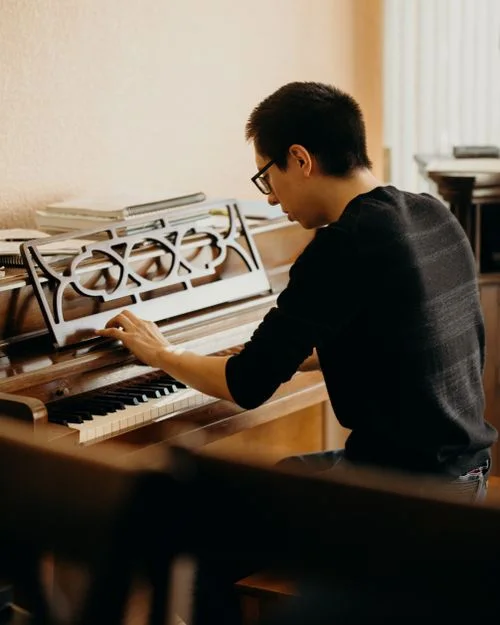
1. Check the keyboard before accessories
Ask which key size, action and pedal features suit the proposed work. An electronic keyboard and acoustic piano do not respond identically. A limited model may support sound exploration without meeting every piano-learning need.
Consider space, seating and sound. If everything needs unpacking before practice, simplify the arrangement. Headphone use depends on the equipment; it does not make every instrument silent to other people.
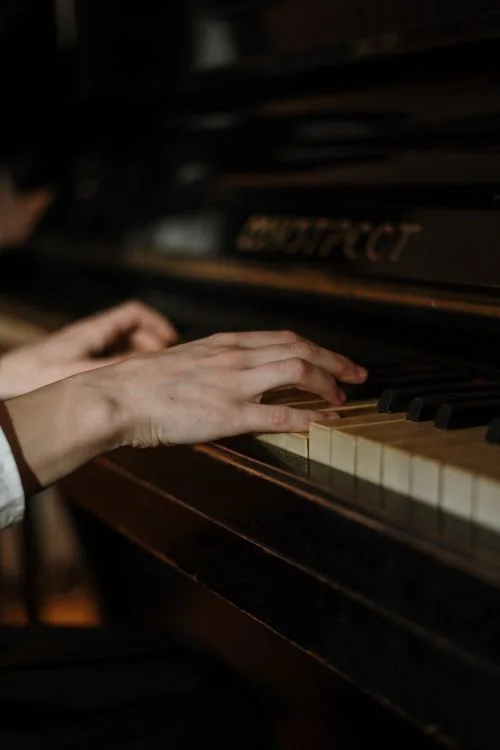
2. Give the camera a clear job
A camera facing your face supports conversation but may not show fingers and movement. Find a stable angle showing hands and some posture without making you twist towards the screen.
Have that view checked before buying a second camera. Light the keys and avoid placing the microphone against a speaker. A teacher needs to distinguish a musical difficulty from a transmission problem.
3. Make the first goal small
Finding a group of black keys, locating a note and playing a small phrase can provide an observable goal. These are general examples to adapt with the teacher, not a promised first-session programme.
Working hands separately may clarify a passage; combining them introduces a different challenge. Avoid adding speed, notes and pedal all at once. Clarity tells you more than a fast but uncertain attempt.
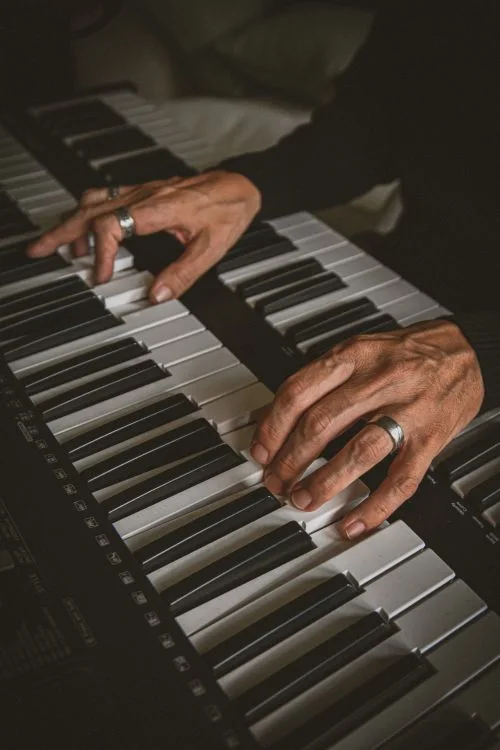
4. Fit practice into adult life
Choose a realistic time and one short task. If you miss a day, resume the task rather than suddenly doubling the duration. Note a specific question for the next lesson and have any painful position checked.
Piano learning does not require an exam goal. Official ABRSM resources nevertheless offer repertoire and progressive activities: use them as a library of ideas, not an obligation to pass a grade by a deadline.
Map what remains after a break
For an adult return, make three columns: recognised concepts, familiar-feeling movements and questions that stop you. You might recognise a written note yet hesitate finding it on the keyboard, or the reverse. This describes a starting situation without assigning a formal level or recovery speed.
If completely new, replace remembered skills with listening interests: melody, accompaniment or understanding the keyboard. Avoid learning vocabulary merely to appear ready to enquire. A plain account of real experience is more useful than an unsupported level label.
A useful bridge for an adult in France: do, ré, mi, fa, sol, la and si correspond to C, D, E, F, G, A and B in the letter notation commonly used in English. Keep this correspondence near the keyboard when switching between a French score and English instructions. ‘Flat’ means bémol, ‘sharp’ means dièse, and ‘key’ can mean either a keyboard key or a musical key depending on the sentence.
Choose a goal compatible with the available keyboard
Check space, seating and regular instrument access before choosing lesson frequency. Mention occasional keyboard access. A package cannot solve the absence of an instrument between meetings. Discuss possible purchases before treating a photograph or advertisement as a recommended model.
An initial goal may be understanding a specific difficulty without immediately choosing a work or examination. These are preparation reference points, not a first-lesson programme. Experience, available time and questions support a clearer conversation about the offer.
To begin without making reading an obstacle, choose three neighbouring keys and name them in both systems before playing slowly. Then keep a steady pulse on a single note. These tasks separate two difficulties: recognising pitches and organising time. They do not remove the need for reading skills; they provide an observable starting point.
A digital piano with headphones may help in shared accommodation, but the mechanical noise of the keys can remain audible. Before buying, ask a practical question: can you practise at the planned time without disturbing others? Also check that the setup lets you hear Zoom instructions and transmit the instrument. Buying a keyboard does not automatically solve audio routing.
If you always stop at the same point, first name the notes without playing, then find them without chasing tempo. If reading is accurate but the hand hesitates, work on a shorter movement. If finding the keys is easy but rhythm slips, keep one note and reproduce the durations. These attempts are not an examination; they help formulate a precise question instead of blaming every difficulty on supposedly being too old to remember.
DR BANERJEE MUSIC · YOUTUBE
Hear a new colour: Lydian at the piano
This Dr Banerjee Music demonstration combines notation and sound. An adult beginner can simply listen: knowing this mode is not a prerequisite for starting piano.
One demonstration. One listening focus.
No YouTube player or thumbnail loads before you click. Loading the video connects you to YouTube, which may process data under its privacy rules.Google privacy.
In C, compare C–D–E–F–G with C–D–E–F sharp–G. The F sharp changes the passage’s colour. Try hearing it first without chasing speed. A modal example does not replace posture, rhythm and reading work suited to your level.
Frequently asked questions
Can I return after a long break?
Yes. Explain your experience and current level; no result timeline is guaranteed.
Should the keyboard be accessible between lessons?
Regular access is useful for practice; discuss equipment features before buying.
How should I describe piano level after a break?
Separate recognised concepts, familiar movements and present questions without inferring a formal level or recovery deadline.
Official resource and context
Plan your next step
Separate a reading error from an uncertain movement: bring one concrete observation to the first conversation.
One free 15–30-minute one-to-one introductory session before enrolment. This is not a regular paid class or a group trial.
The form prepares a WhatsApp or email draft for you to send yourself. Opening a draft does not confirm a booking.
Continue reading
Photographs illustrate the topics; they do not show students, compulsory equipment or brand endorsements.